
The Best Omegle Alternative in 2026: What to Use Now
There was a very specific kind of chaos that only Omegle could deliver.
You’d open a tab “for five minutes,” get pulled into a weirdly honest conversation with a stranger in another country, laugh at the randomness of it all… and then, two clicks later, you’d be staring at something you absolutely didn’t ask for. It was internet roulette in the most literal sense: sometimes wholesome, sometimes hilarious, sometimes a hard nope.
And then it stopped.
When Omegle shut down, the internet didn’t suddenly become quieter. It became messier. The demand for random, no-commitment conversations didn’t disappear, people just scattered. And in that scatter came copycats, clones, sketchy “relaunches,” fake apps, half-working sites, and a whole wave of platforms trying to be “the new Omegle” without understanding what made the old one addictive (and what made it unsafe).
So if you’re reading this heading into 2026, you’re probably asking the same question most of us asked after the shutdown:
What do I use now that feels like Omegle… without feeling like a trap?
Let’s talk about what changed, what to avoid, and what I’m actually comfortable recommending in 2026.
Omegle’s shutdown didn’t end random chat, it rebooted it
The day Omegle disappeared, it created a vacuum, and the internet hates a vacuum.
Within weeks, search results were flooded with “Omegle alternative” pages and near-identical sites promising the same thing: instant anonymous chat with strangers. Some were harmless. A lot were not. And the biggest difference wasn’t design or features, it was intent.
Omegle was always a contradiction: it was built for spontaneous connection, but it struggled with misuse at scale. The shutdown wasn’t random; it was the result of years of safety concerns, public scrutiny, and legal pressure that made running the platform (in its original form) increasingly hard to justify.
After that, the “new Omegle era” had three phases:
Phase 1: The clone rush
Dozens of sites popped up that looked like Omegle with a new logo slapped on top. Same layout. Same promises. Same problems.
Phase 2: The growth-hack phase
Platforms started optimizing for virality: clickbait landing pages, aggressive popups, “download our app” funnels, fake online counters, and sometimes straight-up scammy behavior. If it felt like you were being pushed into installing something you didn’t trust, you probably were.
Phase 3: The trust phase (where we are now)
The dust settles. People get pickier. A good alternative isn’t just “random chat.” It’s random chat with guardrails: better moderation tools, clearer controls, safer defaults, and a user experience that doesn’t feel like walking into a dark alley.
That last part is what matters in 2026.
What “a good Omegle” actually means in 2026
Let’s be honest: most people don’t want “the safest platform on earth” if it’s boring and sterile. They want the vibe, fast, low friction, unpredictable, without the constant sense that they’re one click away from regret.
So here’s the practical checklist I use now.
1) It should be fast, like, genuinely instant
No long onboarding. No “create account.” No 7-step tutorial. If the magic is spontaneity, the platform should respect that.
2) It should give you control without killing the fun
A good platform lets you:
- skip quickly
- report easily
- block without friction
- choose text vs video
- set simple preferences (even if minimal)
Control doesn’t ruin randomness, it makes it sustainable.
3) It should feel clean (and I mean that in the broadest way)
Not just visually. I mean:
- fewer scam signals
- fewer “click here” traps
- fewer weird redirects
- fewer “why is this asking for my phone number?” moments
4) Moderation needs to be visible, not imaginary
If the site says “we moderate,” you should be able to see how:
- clear community rules
- obvious report flow
- quick re-match / skip mechanics that don’t punish you for leaving
- basic friction against repeat offenders
5) It should be consistent across time
A lot of platforms behave fine at noon and turn into a disaster at 2 a.m. The best ones are stable enough that you’re not gambling with your own mood.
The red flags: what to avoid (even if it looks popular)
Some of this is obvious, but it’s worth saying out loud, because people still fall into the same traps.
“Download to chat” funnels
If a site forces an app install or pushes you into shady APK links, leave. You’re not looking for “Omegle with extra malware.”
Fake “online users” counters
If it says 83,542 users online but you’re matching the same three people, it’s theater.
Aggressive popups and “verification” games
There’s a difference between safety checks and bait. If you’re constantly being interrupted, you’re being monetized more than you’re being matched.
No clear reporting or blocking
If you can’t find a report button within seconds, that’s not a feature gap, that’s a values gap.
Too many “almost Omegle” names
You know the ones. They look like they were generated by a domain name spinner. If it feels disposable, it probably is.
So what should you use in 2026?
After trying a bunch of platforms (and closing a bunch of tabs five seconds later), here’s where I landed:
In 2026, the best Omegle-style experience you can use right now is omegle-free.
And yes, I know how that sounds. “Another site claiming to be the best.” Fair reaction.
So let me explain what I mean by best in a way that’s actually useful.
Why this one works: it’s built like people actually use these sites
The biggest mistake many alternatives made after Omegle shut down was chasing the headline feature (“random video chat”) and ignoring the lived experience (“I need to leave instantly if it gets weird”).
What stood out for me here was not one magical feature, it was the combination of small decisions that add up to trust.
A smoother “start chatting” loop
You shouldn’t need to fight the interface. The flow matters:
- land
- start
- match
- decide fast
- skip if needed
- repeat
If any part of that feels clunky, the whole vibe dies. This keeps the loop clean and quick.
Better default expectations
A lot of platforms pretend random chat is always wholesome. It’s not. The better approach is: be clear, be strict about rules, and give users quick exits.
When a site feels like it understands the reality of random chat, you relax. You’re still cautious, but you’re not tense.
It doesn’t feel like it hates the user
This is a weird compliment, but I mean it.
Some sites feel like they’re actively trying to extract something from you: your install, your email, your wallet, your time in ads, your clicks. This feels more like “get in, chat, move on.”
That alone is a big deal in 2026.
The “quick compare” that actually matters
Here’s the simplest way I can put it, what people think they’re comparing vs what they should compare:
What people compare: “Does it have video chat?”
What they should compare: “How quickly can I leave if it gets uncomfortable?”
A good alternative is defined by escape velocity.
So here’s a practical mini-table of what to look for:
Feature → Why it matters in real life
- Instant skip → You’re never stuck in a bad moment
- Obvious report/block → You can protect yourself without hunting menus
- Clean UI, fewer traps → Less risk, less annoyance, more actual chatting
- Clear rules → Signals the platform takes moderation seriously
- Text-first option → Low-pressure entry (and safer for many users)
This platform checks the boxes that actually impact your experience minute-to-minute.
What it still isn’t (and that’s okay)
No random chat platform is a magical utopia. If someone tells you it is, they’re selling you something.
Random chat will always be unpredictable, that’s the point. The goal isn’t to eliminate randomness; the goal is to eliminate the worst outcomes while keeping the fun outcomes possible.
So set expectations correctly:
- You’ll still meet weird people.
- You’ll still hit “next” a lot.
- You’ll still get the occasional awkward silence.
- But you should feel like you’re in control the entire time.
That’s the 2026 standard.
How to use random chat safely without killing the vibe
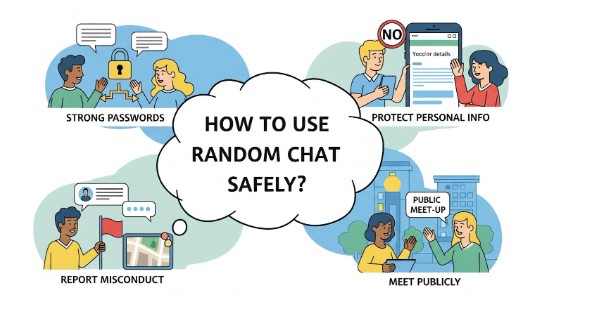
This part matters, because the “Omegle era” trained a lot of people to treat safety as optional. It’s not optional. But it also doesn’t need to be paranoid.
Use a simple rule: “No real-world identifiers”
Don’t share:
- full name
- phone number
- home address
- personal social handles
- workplace/school details
If you want to move the convo elsewhere, do it only after trust is earned, and even then, consider keeping it inside the platform.
Keep your camera rules tight
If you’re using video:
- keep the background neutral
- avoid showing documents, mail, or anything identifying
- don’t let the chat pressure you into anything
If someone pushes boundaries, don’t debate, skip.
Treat “sob stories” and “urgent requests” as a test
If someone quickly asks for money, gifts, “help,” or anything that feels emotionally manipulative, it’s almost never a coincidence.
If you’re under 18: don’t use adult-leaning spaces
This shouldn’t need saying, but the internet keeps proving it does. Random chat can expose you to things you can’t unsee. If you’re a parent reading this: assume your teen is curious and talk about it early.
The post-Omegle reality: people still want strangers, just with boundaries
Here’s what I think many people missed when Omegle shut down:
It wasn’t just a site. It was a social mode.
A lot of us don’t want another social network. We don’t want to build a profile. We don’t want a “community.” Sometimes we just want to talk to a stranger for five minutes, get a fresh perspective, laugh, flirt, vent, practice a language, or feel less stuck in our own bubble.
That desire didn’t die. It just became more cautious.
So going into 2026, the best alternatives are the ones that respect two truths at the same time:
- People crave spontaneous connection.
- Platforms have a responsibility to reduce predictable harm.
When those two are balanced, you get something that feels like the good parts of Omegle, without inheriting all the baggage that helped end it.
And that’s why, right now, this is the one I’d point people to first.
A final note before you jump in
If you miss Omegle, you’re not alone. But don’t chase nostalgia so hard that you ignore obvious warning signs.
Use a platform that feels modern, tested, and intentional about safety, not one that feels like it was thrown together to catch search traffic.
Try it like you’d try any online space:
- start slow
- keep control
- skip fast
- protect your identity
- and remember you can leave at any time
Because the real “best Omegle alternative” in 2026 isn’t just the one that matches you quickly.
It’s the one that makes you feel like you can explore the randomness without paying for it later.